AI Ethics is a Giant Murky Puddle. Here are My Thoughts for Other Dietitians.
Over the last 5 years, I’ve given many presentations about artificial intelligence to dietitians. Inevitably, there are folks in the presentation that voice opinions about how terrible it is that I’m promoting AI use.
Here’s the thing – I’m not pro AI, nor am I anti AI.
I’m pro being informed about the technology, and letting others make their own decisions about if and how to use it.
Risks and Benefits of Use
There are major arguments for why we should limit artificial intelligence use. The servers to power these tools require massive environmental resources, like water. Data centers can raise temperatures in the areas where they’re built. AI tools can spread misinformation and perpetuate bias. These tools were trained on creators’ work (written, visual, audio, etc), almost all of whom were not compensated. It could potentially lead to intellectual laziness.
Heck, as someone that personally built my business around blogging and ad revenue, Google’s AI overviews and the rise of AI slop on Pinterest have massively impacted my traffic and income.
But it would be short-sighted to say that AI does not offer any benefits to dietitians or healthcare. For example, one study found that AI-assisted charting led to more efficient appointments and less after-hours work. Another study found that AI improved adenoma detection rates in colonoscopies.
From a business owner standpoint, it can be quite useful to systematize tedious tasks, freeing up brain power for client work or more complex issues. I personally find it very helpful for creative ideation.
The juxtaposition of the risks and benefits of this technology leads to a very murky gray area as far as ethics go. I find most of the articles on this topic tend to be very idealistic without considering the realities and nuances of the situation. Hence, my thoughts on common arguments (none of which are advice, but just stream of consciousness writing here, haha)…
The “Never Use AI” Argument
Over the last year, I’ve seen a growing contingent of people suggest that artificial intelligence should never be used. If you are passionate about that viewpoint, I absolutely support your right to pursue that stance. I’d like to provide a contrarian take, though.
Recent data from McKinsey suggests that 88 percent of companies reported using artificial intelligence in some way, with 79 percent specifically using generative AI. Many of these use cases are experimental, but that data is still staggering.
Given such, one might argue that it’s a somewhat privileged viewpoint to be able to say someone should “never use AI.” We should not look down on someone that needs to use artificial intelligence because their job requires it. One could certainly take the stance that forced AI use is an organizational failure, but it doesn’t change the fact that some people may have to use it within their role or risk being eliminated. Someone may not be able to take an ethical stance on AI use if their income is required for food and shelter.
Similarly, I’m not sure everyone realizes just how pervasive artificial intelligence is throughout the tools and systems in everyday life. If you’re using Facebook, you’re feeding an AI beast. If you’re Googling anything, there’s an immediate AI overview for most queries (and I’d bet that within the next few years we’ll be defaulting to AI mode there). Watch Netflix? About 300 of their programs utilized generative AI. Use an iPhone? Built with Apple Intelligence.
At this point, if one wanted to completely avoid AI, it seems like the only way would be to go off-grid and stop use of most technology.
Now of course, you may feel differently about certain uses of AI compared to others, and I agree there. Strategic chatbot use is different than creating AI slop videos. Buying an iPhone because you need a phone is certainly different than running rampant with generative AI tools.
My point is simply to illustrate that this is not as clear as “never use it.”
The “We Shouldn’t Teach AI” Argument
In a recent webinar, I received a comment as I was speaking along the lines of “The speaker is just wasting environmental resources with every example she gives in this presentation.”
Ouch. It’s a fair criticism, as using AI does use environmental resources.
But what is the alternative? Should we not have any education on the topic? Should we not illustrate poor versus potentially helpful use cases of artificial intelligence?
(Aa a little bit of a personal defense, I try to reuse as many examples as possible across presentations, as well as showcase actual use cases from my own work, so as not to needlessly waste resources).
Ignoring AI or suggesting we never teach AI seems like we will then just leave individuals without context on benefits, risk, and effective versus ineffective prompting. If someone is determined to use AI, wouldn’t we rather have educated use rather than leaving someone floundering and possibly wasting more environmental resources?
To me, suggesting that we never educate dietitians on AI is akin to abstinence only education (stick with me here, haha). In the public health realm, we know that abstinence only policies do not prevent teen pregnancy. On the contrary, comprehensive educational programs help reduce the risk of risky behaviors.
Similarly, I do not believe that education on AI will increase unethical usage. I think it provides context to help individuals decide what (if any) use cases fit within their own moral and ethical framework (as well as the ethics of their profession).
There have been plenty of educational sessions I’ve attended with uses cases for AI that I personally never implemented because the resource load of that use case outweighed the benefits. I think educating others to assess this is important.
The “Label All AI Use” Argument
Transparency is important in artificial intelligence use. But I’m wondering if labeling every single instance of AI will simply dilute its effectiveness – aka “if everything is AI, then nothing is AI”. It’s a controversial thought, I know.
As an example, if I used an AI chatbot to brainstorm creative recipe ideas based on some trending Pinterest topics, and then create a recipe based on that in my kitchen using my own testing, should I disclose that I used AI for brainstorming?
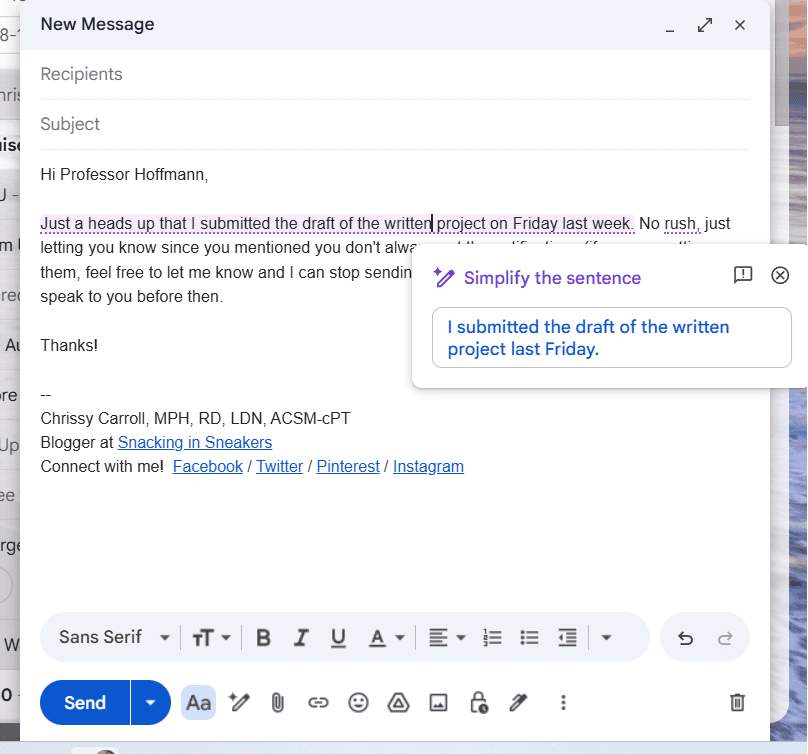
If I’m writing an email in Gmail and use the “simplify sentence” button that pops up, should I be adding an annotation to the bottom of that email that says I used AI?
A few creators have noted that Meta may flag content that uses Canva’s background remover as AI. Does flagging a creator’s original content with no background achieve the same purpose as flagging blatant AI slop?
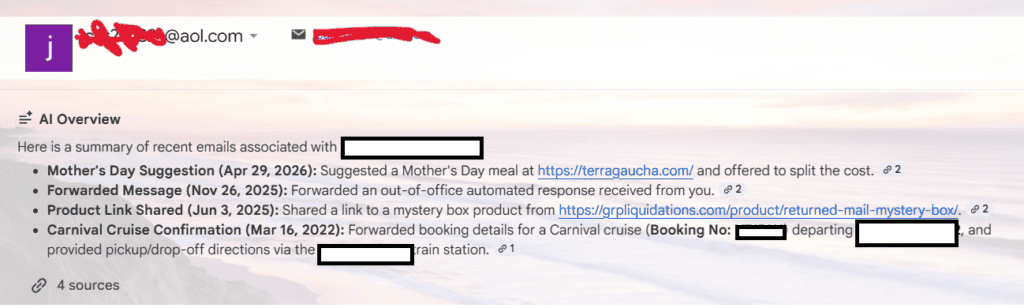
What if I search Gmail to find information associated with an email, and I get an AI overview that gives me the information I was looking for without clicking on the email? Do I need to disclose that to the individual the next time I talk to them? (“Hey mom, I used AI in Gmail to find the name of the Mother’s Day restaurant you wanted a gift card for.”)
You may think all of these do need labels. You may think it would be ridiculous for all these to have labels.
I’m hoping to simply highlight that use cases are very widespread, and I’m wondering if AI disclosures across all these scenarios dilute the strength of AI content that really need disclosure?
I don’t know that there is a right answer.
(Add in the fact that social platforms may label content that’s not AI as AI – and it becomes even more challenging for the average consumer to sift through this information.)
Where I do think transparency and disclosure are essential are in situations where AI use may impact how someone interprets or evaluates the content, or if their own personal information is being used within an AI system.
For example, I believe AI charting should always have informed consent, as an individual should have the autonomy to determine if their information is being used in that way. If AI substantially creates a piece of work (text, image, etc), disclosure seems essential. If AI is being used in a chat scenario in your business, it’s important for someone to realize that they’re speaking to a robot. If a student is using AI for classwork, it should be referenced.
It’s also important to note that there are some legal updates regarding AI disclosure, like EU labeling guidelines, and there will surely be more of these introduced. Obviously, we should comply with whatever legal requirements are outlined.
The “Never Use AI Images” Argument
First, let me say, I’m as sick of homogenized AI flyers as the next person. And as someone that has been food blogging for a long time, I can’t stand the rampant AI slop on Pinterest of clearly-AI generated recipes.
But should it be a blanket statement that we should never use AI images?
If you’re concerned about the environmental impact, that may be a hard stance for you, and I completely understand.
That said, I don’t personally think AI images are always bad or unethical.
Let’s take a food blog: I don’t believe that food blogs should have AI images of their final recipes. I find it disingenuous, as it’s not usually what the end dish looks like (and most AI food images are from AI slop websites that have never actually tested a recipe).
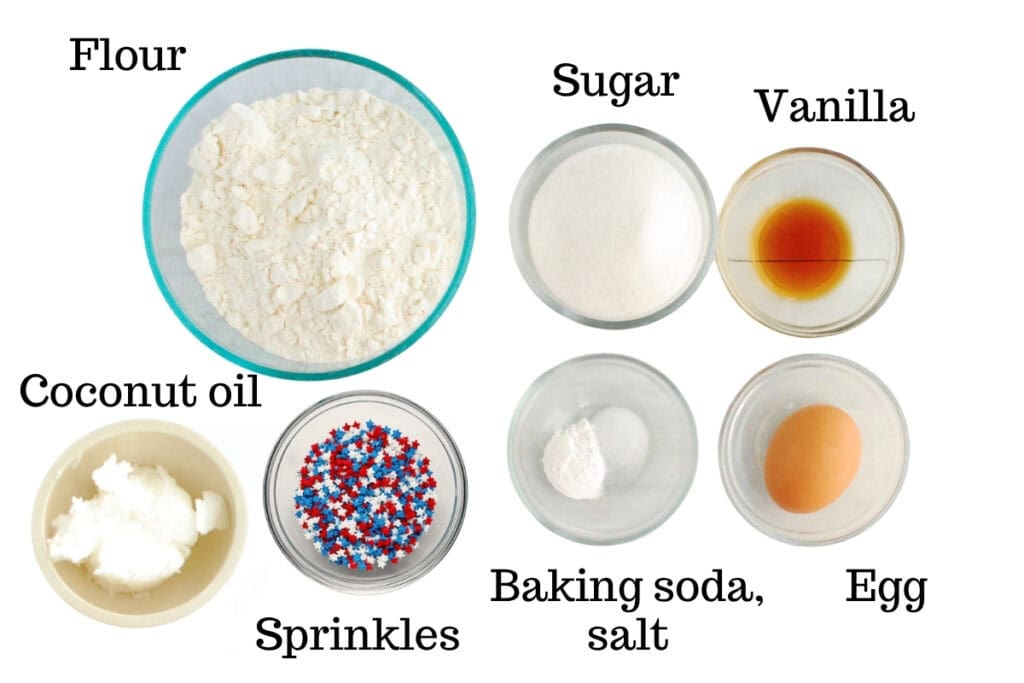
However, there have been occasional times where I’ve taken an ingredient photo and forgotten one of the ingredients. Would you find it wrong if I used AI to fill in that one missing ingredient? Here’s an example where I forgot to include the star sprinkles in the ingredient photo and ran out during cooking, so I didn’t have any more to re-photograph after. I added them in with AI during editing (only the sprinkles are AI-generated in the image below):
You might think it’s wrong, you might not, but again – it’s a bit of a gray area.
Similarly, I think there can be a role for AI in creating infographics that help illustrate a concept or tell a story. Judicious use is essential, of course, as we don’t want to waste resources.
The Bottom Line
Conversation around AI and ethics are essential, but black-and-white thinking can present challenges. I’m not sure universal rules are the answer. I’m actually not sure there are any clear answers.
I think critical thinking – about whether it’s necessary or helpful to use AI for the particular scenario, the assessment of environmental resources, whether labeling helps or hinders in that instance – is key to assess each time. Of course, we all have our own moral and ethical frameworks to consider this within, which is why I’m not sure we’ll ever all come to a clear agreement on this topic. But I hope this article was a bit thought-provoking in showcasing my own though process on this topic.


You May Also Like

18 Time Management Tips for Busy Bloggers

15 Side Hustles for Dietitians to Make Extra Money